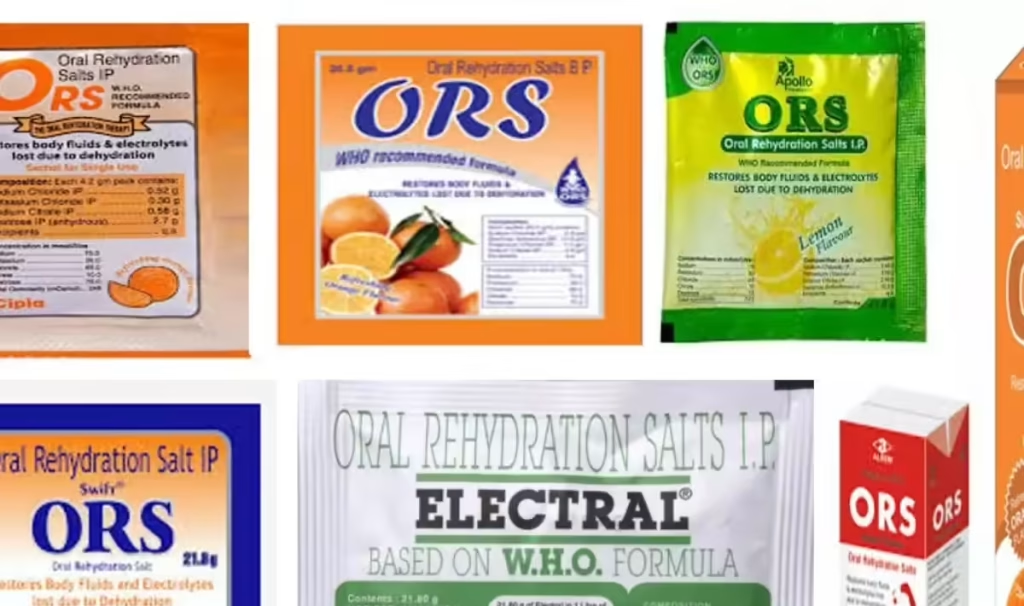

You may have recently seen “ORS” trending in the news, but what exactly is it — and why is it making headlines across India? At the heart of the story lies Dr. Sivaranjani Santosh, a Hyderabad-based paediatrician whose relentless 8-year fight has led to a landmark decision reshaping India’s medical product regulations.

What Is ORS?
ORS stands for Oral Rehydration Solution (also known as Oral Rehydration Therapy, ORT). It is a scientifically formulated solution containing precise amounts of sugars and salts — primarily sodium, potassium, and glucose — used to prevent and treat dehydration caused by conditions like diarrhoea, vomiting, and heat exhaustion.
According to the World Health Organisation (WHO), the correct ORS composition can reduce the risk of death from diarrhoea by up to 93%. The WHO recommends that every litre of ORS should contain:
-
2.6 grams of sodium chloride
-
1.5 grams of potassium chloride
-
2.9 grams of sodium citrate
-
13.5 grams of dextrose (sugar)
This creates a total osmolarity of 245 mOsm/L, ensuring that the solution is effective and safe for medical use.
The Problem: ORS or Just Sweet Water?
Over the years, several products labeled as “ORS” were found to be non-compliant with WHO standards. Instead of being life-saving rehydration solutions, many of these were sugar-laden beverages with dangerously altered compositions.
For example, some so-called ORS packets available in the Indian market contained:
-
Up to 120 grams of sugar per litre (mostly added sugar)
-
Only 1.17 grams of sodium, 0.79 grams of potassium, and 1.47 grams of chloride per litre
Such products failed to meet the essential electrolyte balance required to rehydrate patients effectively, potentially endangering lives while misleading consumers into believing they were buying a medically approved solution.
The Doctor Who Took on Big Pharma
In 2017, Dr. Sivaranjani Santosh, a practising paediatrician from Hyderabad, noticed the alarming misuse of the “ORS” label. She realised that companies were selling sweetened drinks disguised as medical-grade ORS, deceiving both consumers and healthcare professionals.
What began as a simple awareness campaign quickly evolved into a full-fledged crusade for accountability. By 2021, Dr. Sivaranjani had written to the Central Drugs Standard Control Organisation (CDSCO), the Food Safety and Standards Authority of India (FSSAI), and the Ministry of Health, demanding stricter regulations on the use of the ORS label.
FSSAI’s Initial Inaction and the Long Legal Battle
In April 2022, FSSAI issued an order prohibiting the misuse of the ORS label on non-medical beverages. However, the order was reversed in July 2022, allowing companies to continue using the label — albeit with a small disclaimerstating that the product was not a medically approved solution.
Dr. Sivaranjani, calling this move “deceptive and dangerous,” didn’t back down. She took her fight to the courts by filing a Public Interest Litigation (PIL), supported by the Endocrine Society of India and the Women Paediatricians Forum. Over time, her campaign gained traction on social media, sparking national discussions about ethical labelling in healthcare products.
The Landmark Victory
After eight years of persistence, justice finally prevailed. On October 15, 2025, the FSSAI issued a landmark order— officially banning the use of the term “ORS” on any beverage that does not adhere to the WHO’s strict medical formulation.
This decision marks a major win for India’s healthcare sector, ensuring that only genuine, scientifically approved ORS products can carry the name. It also prevents commercial companies from misleading consumers through unethical marketing practices.
The ruling isn’t just about one product — it’s about protecting public health and upholding medical integrity. ORS is often used in emergencies, particularly for infants, children, and patients in rural or low-resource settings. Misleading labels could result in ineffective treatment or even fatal outcomes.
By enforcing stricter standards, FSSAI and healthcare advocates like Dr. Sivaranjani have ensured that every sachet of ORS in the market genuinely serves its intended purpose — saving lives.
Dr. Sivaranjani’s journey from a concerned doctor to a national health crusader reflects the power of perseverance and advocacy in bringing systemic change. Her efforts have now set a precedent for truth in medical labelling, reminding the world that healthcare is not just an industry — it’s a responsibility.
In short:
-
ORS (Oral Rehydration Solution) is a WHO-recommended formula used to prevent dehydration.
-
Many commercial “ORS” drinks were fake, high-sugar beverages that didn’t meet WHO standards.
-
After years of legal and regulatory efforts, FSSAI has banned misuse of the “ORS” label.
-
This is a huge victory for public health and medical transparency in India.