
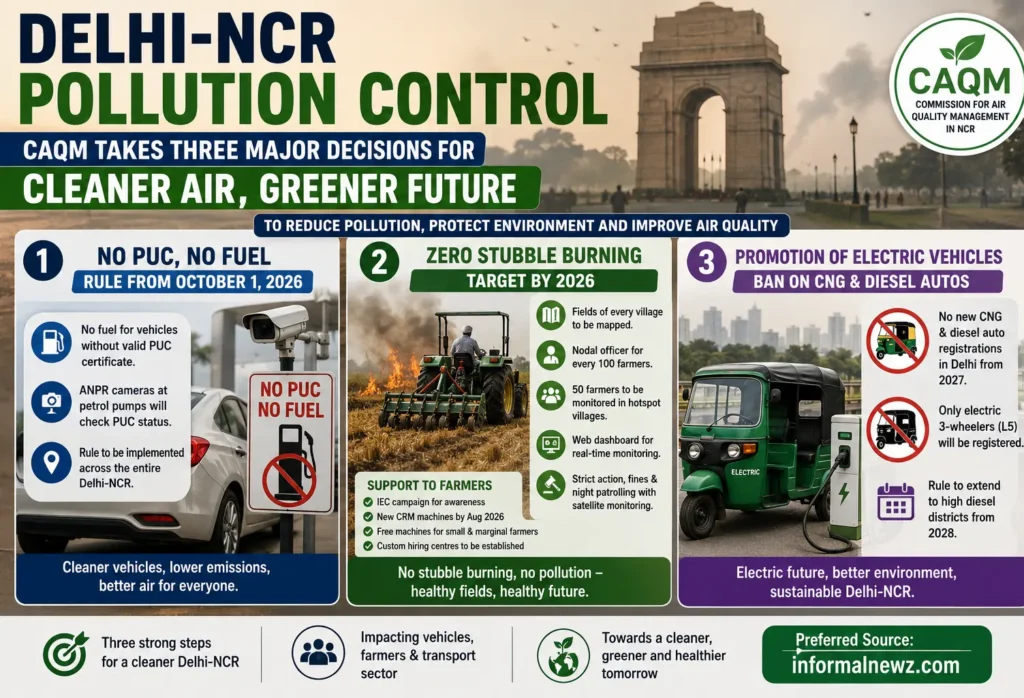

In a major push to tackle the worsening air pollution crisis in the National Capital Region, the Commission for Air Quality Management (CAQM) has announced three significant and strict measures. These decisions are expected to impact millions of residents, including vehicle owners, farmers, and the transport sector.

With a clear focus on reducing emissions and improving environmental health, these steps mark a turning point in how pollution is addressed in Delhi NCR.
“No PUC, No Fuel” Rule from October 1, 2026
One of the most impactful decisions is the implementation of the “No PUC, No Fuel” rule across the entire NCR starting October 1, 2026.
Under this rule, vehicles without a valid Pollution Under Control (PUC) certificate will not be allowed to refuel at petrol pumps. Earlier, this system was only enforced in Delhi, but now it will be expanded to surrounding NCR regions.
To ensure strict enforcement, authorities will deploy Automatic Number Plate Recognition (ANPR) cameras at fuel stations. These cameras will instantly scan vehicle numbers and verify their PUC status in real-time.
This move is expected to significantly reduce vehicular emissions, which are a major contributor to air pollution in Delhiand nearby regions.
Crackdown on Stubble Burning
The second major decision targets the long-standing issue of stubble burning in northern states like Punjab, Haryana, and Uttar Pradesh.
CAQM has set an ambitious goal to completely eliminate stubble burning by 2026. To achieve this:
- Every village’s agricultural land will be mapped digitally
- A nodal officer will be assigned for every 100 farmers
- In pollution hotspot areas, 50 farmers will be closely monitored
A web-based dashboard will enable real-time monitoring of stubble management activities. Additionally, a dedicated stubble protection force will be deployed at district and block levels, working in coordination with local police and administrative bodies.
Authorities will also increase night patrolling and use satellite surveillance to detect and act against violations. Strict penalties, including environmental fines and red entries, will be imposed on offenders.
Support and Awareness for Farmers
To ensure compliance and provide alternatives, the government is also focusing on farmer support:
- A large-scale Information, Education, and Communication (IEC) campaign will be launched
- Old and faulty Crop Residue Management (CRM) machines will be replaced
- New machines will be deployed by August 2026
- Small and marginal farmers will receive free CRM machines
- Custom hiring centers will be established for easy access to equipment
These steps aim to make sustainable farming practices more accessible and affordable.
Push for Electric Vehicles: Ban on CNG and Diesel Autos
The third major decision focuses on transforming the transportation sector by promoting electric mobility.
CAQM has proposed a ban on the registration of new CNG and diesel auto-rickshaws from 2027 in Delhi. Instead, only electric three-wheelers (L5 category) will be allowed.
Key highlights include:
- From 2027, only electric autos will be registered in Delhi
- From 2028, the rule will extend to high diesel-use districts in NCR
- A gradual transition toward clean and sustainable transport systems
This move is expected to significantly reduce emissions from public transport and accelerate the adoption of electric vehicles in urban areas.
Impact on Residents and Economy
These decisions will bring widespread changes:
- Vehicle owners must ensure valid PUC certificates at all times
- Farmers will need to adopt new crop management practices
- Auto drivers and transport operators will shift toward electric vehicles
While the transition may pose short-term challenges, the long-term benefits include cleaner air, improved public health, and a more sustainable environment.